

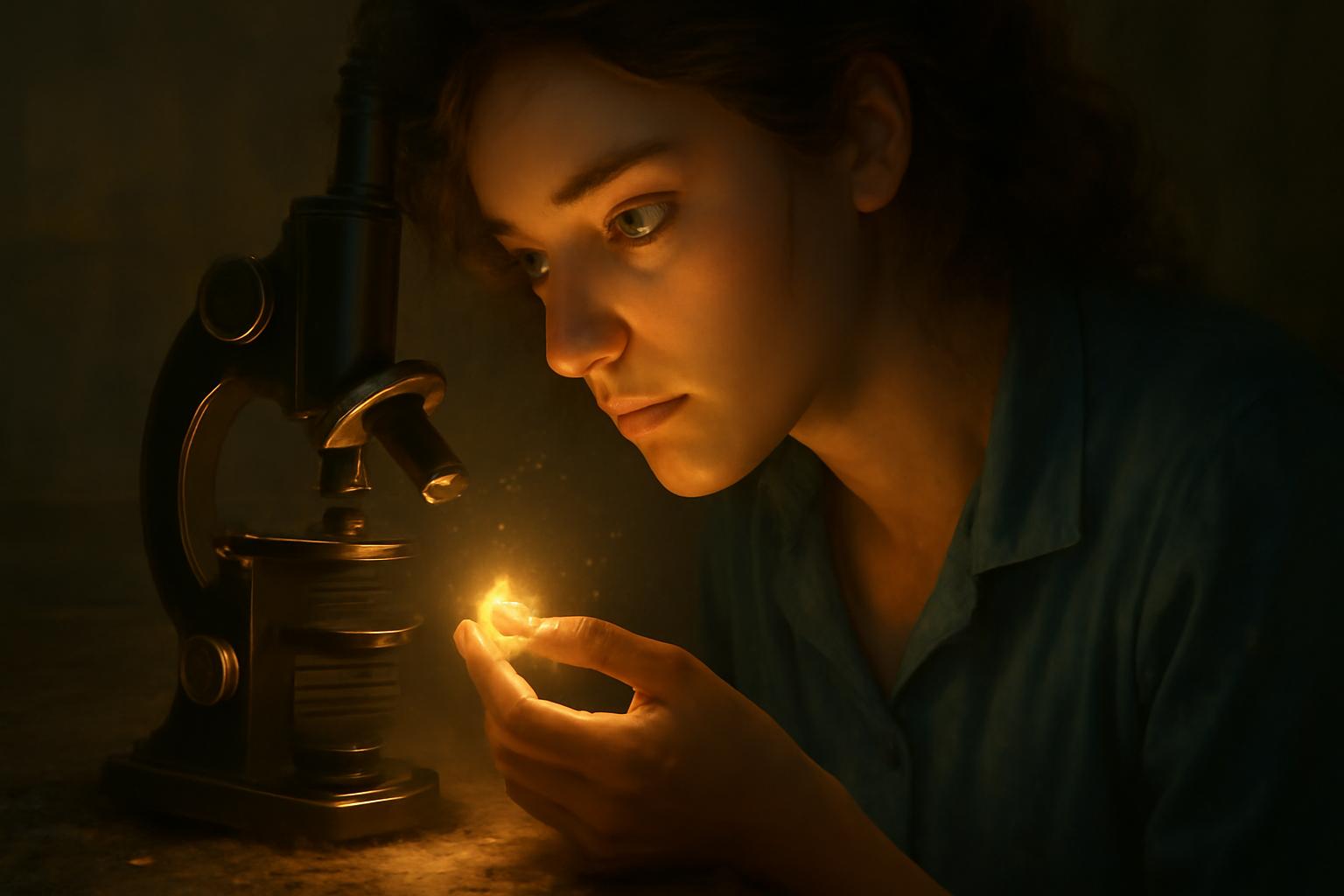
Most people don’t look closely at sand.
It slips through fingers.
It scatters.
It collects in quiet corners and blows across forgotten roads.
Sand is what remains after everything else has been worn away.
But to Liora, sand was a universe.
A tiny, infinite universe.
She’d loved microscopes since she was six — since the day her mother lifted her onto a stool in their small coastal lab and showed her how every grain of sand was different. Some were crystal clear. Some orange. Some pink as coral.
Her mother had laughed softly.
“Everything looks the same until you care enough to notice the details.”
But her mother had been gone for five years now, taken suddenly by an illness neither oceans nor hope could cure.
And Liora, now 22, had inherited both the lab and her mother’s habit of caring enough to notice the small things.
This was why, late one night under a single desk lamp, she found the grain of sand that wasn’t a grain at all.
She almost missed it.
It was smaller than the others — barely half a millimeter, shimmering faintly in a way that had nothing to do with the lamplight. Liora frowned and nudged it with a slender brush. It felt heavier than it should. Dense.
Odd.
She set it under the microscope and adjusted the focus.
Then she forgot how to breathe.
Inside the grain — impossibly, undeniably — was a landscape.
Not fuzzy shapes. Not illusions.
A landscape.
A full world.
She leaned closer, adjusting the magnification.
There were mountains — tiny, jagged, carved in perfect detail.
Rivers — threads of light flowing through carved valleys.
And at the center, a city — gleaming, golden, set upon a hill.
She whispered, “No way.”
But the image sharpened further, and she flinched back.
There were people.
Tiny figures moving along bridges.
Shadows crossing rooftops.
Glittering lights that had to be windows.
Smoke curling from microscopic chimneys.
A kingdom.
In a single grain of sand.
Her heart pounded so hard it blurred her vision. She blinked rapidly, leaned in again.
A pulse of light flashed from the city — like a beacon. A signal.
A moment later, something else moved at the hilltop.
A figure stepped forward.
Not one of the small, indistinct shapes she’d seen before.
This one was larger. Clearer.
As though it were looking back at her.
Liora recoiled so hard she nearly knocked the microscope off the table.
“No,” she whispered. “That’s impossible.”
Her hands shook as she steadied the table.
But curiosity, warm and aching, tugged her back.
She lowered her eye to the lens.
The figure raised a hand.
In greeting.
Or recognition.
Or both.
Light blossomed from its palm — a soft, golden glow that filled the microscope’s field.
And then the world went dark.
When she opened her eyes, she was lying on her back.
Not on the lab floor.
On grass.
Warm. Soft. Sweet-smelling.
She sat up with a cry.
The horizon stretched around her in breathtaking clarity — mountains golden in sunrise light, rivers shining like ribbons of glass.
Far below, a city shimmered.
Liora gasped out loud.
She was inside the grain of sand.
Somehow — impossibly — she had been pulled into the tiny world.
Into the Lost Kingdom.
Voices approached.
Gentle footsteps padded over the grass.
She turned — slowly, afraid of what she might see — and found herself facing three figures.
Human-shaped. Human-sized.
Robed in soft gold that caught the morning light.
Eyes bright like molten amber.
One stepped forward.
A woman — tall, serene, with hair that flowed like metal strands.
“Welcome, Liora of the Outer World.”
Liora stumbled to her feet. “You… you know my name?”
“Your mother spoke of you often.”
Her heart stuttered.
“My mother?”
The woman nodded.
“She visited us before you were born. She promised to return one day, when the world’s grief called her back.”
Liora’s throat tightened painfully.
“She never told me…”
“She carried many burdens,” the woman said softly. “But her love for you was not one of them.”
Emotion swelled like a storm inside Liora.
“You knew her,” she whispered. “You really knew her.”
“Yes.”
The woman extended a hand.
“I am Amaris, Keeper of the Grain. And your mother was our friend.”
Liora stared at the hand, then took it.
Warmth flowed through her like sunlight.
“You said she promised to return,” Liora murmured. “But she never did.”
Amaris’s expression softened.
“She meant to. The path between worlds closes unless summoned by need. And we felt your need before you did.”
Liora swallowed hard.
“You brought me here because I miss her,” she said, voice breaking.
“We brought you here,” Amaris corrected gently, “because the grief you carry is heavier than any world — and no one is meant to hold such weight alone.”
Tears spilled freely.
Liora didn’t wipe them away.
Amaris led her down the hillside toward the kingdom.
The air smelled of honey and sea salt.
The city walls shimmered like they were carved from starlight.
Everything hummed faintly — alive, aware.
People greeted her as she passed.
Not with fear.
Not with awe.
But with warmth.
Like they recognized her.
Like they had been waiting.
“Why am I here?” Liora whispered to Amaris as they approached a gate carved with swirling constellations.
“To learn what your mother learned,” Amaris said softly. “And to leave lighter than you arrived.”
They passed into a courtyard filled with golden trees whose leaves chimed like tiny bells in the breeze. At the center was a circular pool — perfectly still, reflecting a sky that was not the sky above.
“Look,” Amaris said gently.
Liora stepped closer.
In the pool, instead of her reflection, she saw her mother.
Not sick.
Not tired.
Radiant. Laughing.
Younger than Liora had ever known her.
Liora gasped.
Her mother turned — not to the side, not away — but directly at her.
Her mother saw her.
“Mama?” Liora whispered, choking on the word she hadn’t said since she was seventeen.
Her mother smiled — soft, glimmering at the edges like she was made of light.
“My Liora,” she said. “You found the way.”
Liora fell to her knees, sobbing.
“I miss you,” she gasped. “I miss you so much it hurts everywhere.”
Her mother lifted a hand — pressed it against the surface of the reflection.
Liora pressed hers to it.
Warmth spread through her fingertips.
“You were never alone,” her mother murmured. “Not in the world above. Not in your grief. Not in your days. You carry my stories. You carry my love.”
“I don’t want to forget you,” Liora sobbed.
“You never will,” her mother whispered. “But you must remember to remember the joy, too. Not only the ending.”
Liora cried until she had no sound left.
When she lifted her head, the reflection dimmed — but the warmth stayed in her chest.
Amaris placed a gentle hand on her shoulder.
“This kingdom exists,” she said, “to preserve what pain tries to erase.”
Liora wiped her face. “Will I ever see her again?”
“In this pool?” Amaris said softly. “Only when the need is true.”
“But in your heart?” She smiled. “Always.”
When Liora returned to her world — waking with a gasp at her lab desk — a single golden grain of sand lay next to her hand.
Different from the one she’d found.
This one was warm.
Alive.
And inside it, if she held it close and closed her eyes, she could feel the faint hum of the Lost Kingdom.
Not gone.
Not lost.
Just waiting.
And she knew:
Every time grief grew heavy, every time memories felt too sharp to hold, she could return — not by falling into sand, but by remembering what she carried.
A whole world.
A whole love.
A whole piece of her mother.
Inside a single grain of sand.